
Last verified: October 6, 2026, against St. Johns River Water Management District.
Jacksonville homeowners are paying more attention to water use than ever before. The St. Johns River Water Management District sets watering restrictions year-round, and properties with large St. Augustine lawns face significant water bills during the dry months between October and May when rainfall drops off and irrigation picks up the slack. For homeowners looking to reduce water consumption, lower maintenance costs, and create a landscape that thrives in Northeast Florida’s conditions without constant intervention, xeriscaping is the smartest investment you can make.
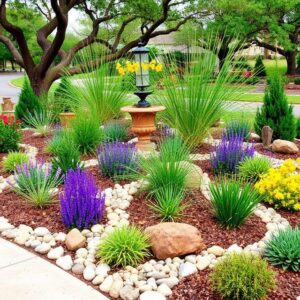
Xeriscaping is not the gravel-and-cactus look that the word sometimes conjures. In Jacksonville, a well-designed xeriscape includes lush native greenery, colorful flowering shrubs, natural stone features, and even small areas of turf — all designed around plants that evolved in or adapted to our sandy soil, humid climate, and coastal conditions.
This guide covers everything Jacksonville homeowners need to know about xeriscaping — from the best plants to use, to design principles, to costs, to compliance with local watering rules.
What Is Xeriscaping?
Xeriscaping is a landscaping approach that reduces or eliminates the need for supplemental irrigation. The term comes from the Greek xeros, meaning dry. The key principles are selecting plants adapted to your local climate and soil, grouping plants by water needs, improving soil to maximize moisture retention, and designing irrigation systems that deliver water efficiently to root zones rather than broadcasting it across the entire landscape.
In Jacksonville, xeriscaping means designing for Northeast Florida’s specific conditions: sandy soil that drains fast and holds almost no moisture or nutrients, humid subtropical climate with intense summer rainfall followed by dry fall and winter periods, salt air exposure on coastal and near-coastal properties, and St. Johns River Water Management District watering restrictions that limit supplemental irrigation, currently to one day a week in areas under the Phase III Extreme Water Shortage.
Best Xeriscaping Plants for Jacksonville
Flowering Shrubs and Perennials
Firebush (Hamelia patens) — One of the best flowering shrubs for Jacksonville. Produces clusters of red-orange tubular flowers from spring through fall that attract hummingbirds and butterflies. Thrives in full sun, tolerates sandy soil, and requires minimal supplemental watering once established. Dies back in hard freezes but returns reliably from the roots.
Muhly Grass (Muhlenbergia capillaris) — Dramatic pink-purple plumes in fall that are the signature of Florida-friendly landscaping. Native to Florida. Zero supplemental water once established. Thrives in sandy soil and full sun. Low maintenance — cut back once per year in late winter.
Coontie (Zamia integrifolia) — Florida’s only native cycad. Deep green, palm-like foliage that thrives in shade or full sun equally. Extremely drought-tolerant once established. The host plant for atala butterflies. Virtually pest-free and maintenance-free.
Lantana (Lantana camara) — Produces colorful blooms from spring through frost in yellow, orange, red, and multi-color varieties. Attracts butterflies. Extremely drought-tolerant and salt-tolerant, making it ideal for coastal Jacksonville properties.
Blanket Flower (Gaillardia pulchella) — Red and yellow daisy-like flowers that bloom nearly year-round in Jacksonville. Native to Florida. Thrives in sandy soil with no amendment needed. Salt-tolerant.
Walter’s Viburnum (Viburnum obovatum) — Versatile native shrub with white spring flowers and dense evergreen foliage. Works as a hedge, specimen, or foundation planting. Tolerates wet and dry conditions equally well.
Architectural Plants and Groundcovers
Sabal Palm (Sabal palmetto) — Florida’s state tree. Hurricane-resistant, salt-tolerant, drought-tolerant, and iconic. The definitive palm for Jacksonville landscapes.
Saw Palmetto (Serenoa repens) — Native groundcover palm that provides year-round green mass in large landscape areas. Extremely tough and virtually maintenance-free. Wildlife habitat value.
Beautyberry (Callicarpa americana) — Native shrub with stunning purple berry clusters in fall. Grows well in partial shade and sandy soil. Provides food for birds and visual interest in the landscape.
Simpson’s Stopper (Myrcianthes fragrans) — Compact native evergreen with fragrant white flowers and orange berries. Salt-tolerant and drought-tolerant. Excellent for foundation plantings and hedges.
Trees for Xeriscaping
Live Oak (Quercus virginiana) — The iconic Jacksonville shade tree. Massive, wind-resistant, long-lived, and drought-tolerant once established. Defines the character of Northeast Florida’s best neighborhoods. Semi-evergreen — drops old leaves in spring as new growth emerges.
Bald Cypress (Taxodium distichum) — Native to Florida’s wetlands but surprisingly drought-tolerant once established in landscape settings. Feathery foliage, distinctive trunk flare, and beautiful fall color. Handles both wet and dry conditions.
Red Maple (Acer rubrum) — Fast-growing native shade tree with brilliant red fall color. Adapts to sandy soil and tolerates periodic flooding. One of the best shade trees for Jacksonville residential landscapes.
Southern Magnolia (Magnolia grandiflora) — Evergreen with large glossy leaves and fragrant white flowers. Iconic in Southern landscapes. Drought-tolerant once established and handles Jacksonville’s sandy soil well.
Xeriscape Design Principles for Jacksonville
Plan and Design — Start with a site analysis. Map sun exposure, soil drainage, wind patterns, salt exposure on coastal properties, and existing features. Group plants by water needs — this is called hydrozoning. Plants that need regular moisture go near the house where irrigation is efficient. Drought-tolerant plants go in outlying areas where supplemental water is minimal.
Improve Soil — Jacksonville’s sandy soil benefits significantly from adding compost and organic matter to planting beds. Amended soil holds moisture longer, retains nutrients, and gives root systems a better medium to establish in. For areas with particularly fast-draining sand, mixing in expanded shale or composted pine bark improves water retention without sacrificing drainage.
Appropriate Turf — If you want some lawn, use the smallest amount necessary and choose the right grass. Bahia is the most drought-tolerant turf option commonly used in Jacksonville. St. Augustine looks lusher but requires significantly more water. Limit turf to functional areas — play space, entertaining areas, pathways — and fill the rest with native plantings and mulched beds.
Efficient Irrigation — Drip irrigation for all planting beds. Spray heads only for remaining turf areas. Smart controllers that adjust schedules based on weather data and seasonal changes. Rain sensors as required by Florida law. A properly designed drip system uses 40 to 60 percent less water than overhead spray in landscape beds.
Mulch — Three to four inches of pine bark, pine straw, or hardwood mulch in all planting beds. Mulch reduces evaporation by up to 70 percent, suppresses weeds, moderates soil temperature, and breaks down over time to add organic matter back into Jacksonville’s nutrient-poor sandy soil.
Proper Maintenance — Xeriscapes require less maintenance than traditional landscapes, but they are not maintenance-free. Seasonal pruning, mulch refreshing, weed management, and irrigation system checks keep a xeriscape looking its best. The maintenance savings compared to a traditional all-turf landscape are significant — less mowing, less fertilizer, less pest treatment, and dramatically less water.
Front yard xeriscape conversion typically runs $5,000 to $12,000 depending on size, plant selection, and whether hardscape elements like pathways or dry creek beds are included. Full property xeriscaping ranges from $10,000 to $25,000 or more for larger properties with extensive hardscape features and mature specimen plantings. Small accent areas — converting a single bed or problem area — can be done for $1,500 to $3,000.
The return on investment comes from reduced water bills, lower maintenance costs, and increased property value. Jacksonville homebuyers increasingly prefer low-water, low-maintenance landscapes, and a well-designed xeriscape adds real curb appeal that a patchy, drought-stressed St. Augustine lawn cannot match.
Watering Rules and Water Savings
The St. Johns River Water Management District sets the watering rules. In normal conditions, irrigation is limited to two days a week during daylight saving time, with no watering between 10 a.m. and 4 p.m. Under the Phase III Extreme Water Shortage order now in effect for portions of Duval County and neighboring counties, landscape irrigation is limited to one day a week and prohibited between 8 a.m. and 6 p.m. A xeriscape designed with native and Florida-friendly plants can thrive on rainfall alone for most of the year, with minimal supplemental irrigation during dry periods. That keeps a property well within the restrictions and significantly reduces the water bill.
For homeowners considering a xeriscape conversion, Jacksonville Pro Landscape provides free design consultations. We assess your property, discuss your goals, and develop a design plan built around plants proven to perform in Duval County’s specific conditions.
Contact Jacksonville Pro Landscape at (904) 747-8308 or fill out our form for a free xeriscape design consultation.
Jacksonville scope step
Use the article to separate confirmed needs from items that require an on-site decision.