
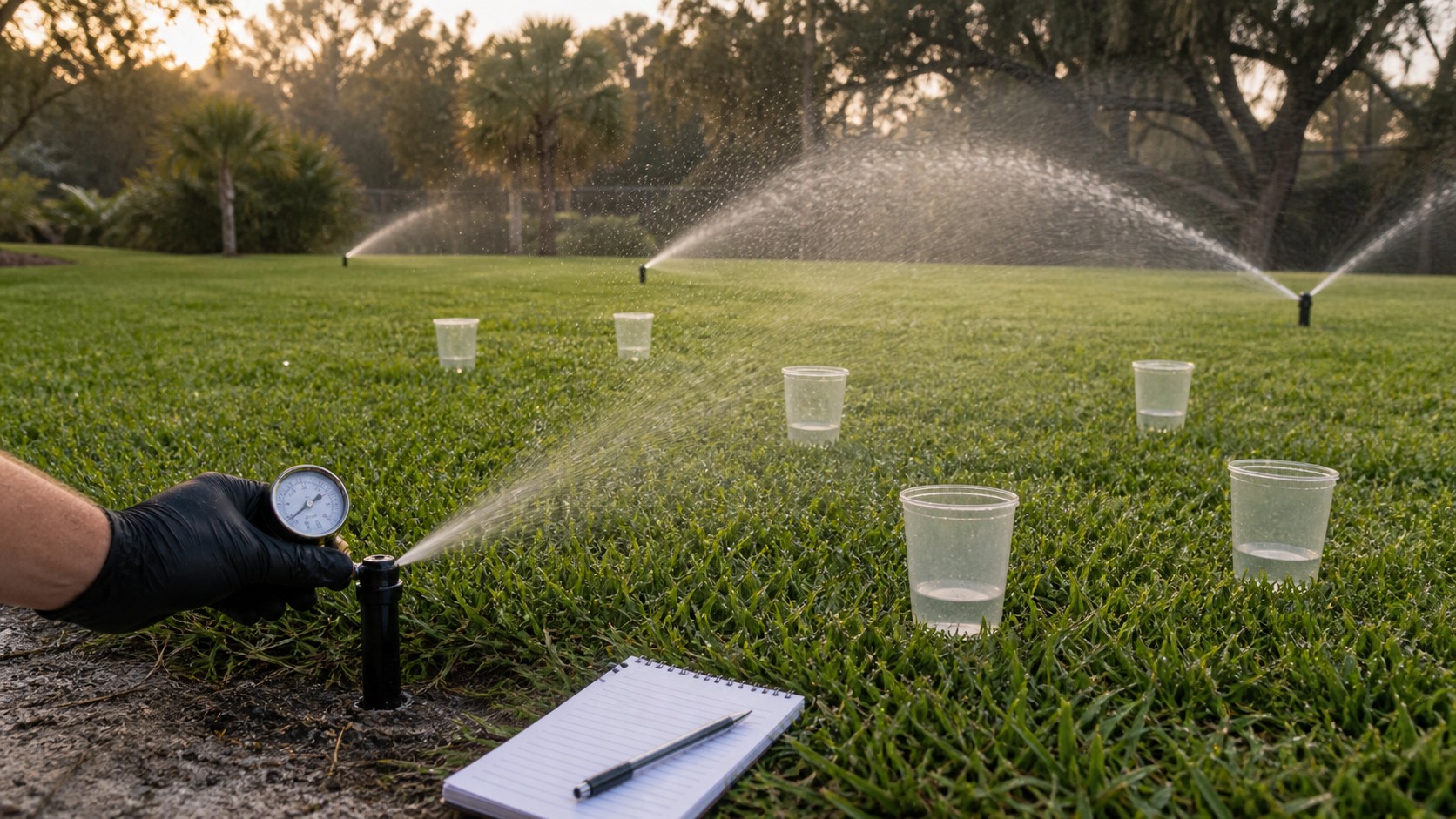
When one Jacksonville sprinkler zone leaves pale turf, throws short arcs, or creates wet and dry stripes, changing the controller is rarely the first useful move. The controller proves only that a run command was sent. The fault can sit at the valve, pipe, filter, riser, head, nozzle, pressure boundary, or layout itself.
Read the spray pattern before touching the controller
Run only the suspect zone and watch from startup through steady operation. Record which heads rise late, fail to seal, mist, tilt, pulse, spray pavement, or stop short of the next head. Mark soft ground, bubbling soil, unusually green strips, water at valve boxes, and places where roots or recent digging cross the lateral line.
UF/IFAS separates irrigation defects into useful families: pressure and application rate, emitters and sprinklers, system maintenance, landscape obstruction, drainage, and operating time. That matters because adding minutes cannot correct a broken pipe, mismatched nozzle, leaning head, blocked stream, or pressure outside the component’s design range.
Let the zone-wide pattern choose the first branch
| Observed pattern | First checks | What not to conclude yet |
|---|---|---|
| Every head is short or slow to rise | Confirm the valve opens fully; compare pressure while off and running; inspect filters; look for a large downstream leak; count the active head demand | Do not buy larger nozzles. Higher flow demand can lower pressure further. |
| Only one head is weak | Clean the nozzle and screen; check for a damaged riser, leaning body, buried head, or local root pressure; compare the installed nozzle with its neighbors | Do not lengthen the entire zone for one local defect. |
| One half of the zone fades | Trace the lateral between the last strong and first weak head; inspect for a crushed or leaking pipe and elevation change | Do not assume the source pressure is low when the upstream half performs normally. |
| Fine mist forms around several heads | Measure dynamic pressure and compare it with the manufacturer’s operating range; inspect pressure regulation | Mist is not evidence that the lawn is receiving uniform usable water. |
| Heads spray well but cups vary sharply | Check head-to-head spacing, arc, nozzle family, obstructions, wind, and mixed precipitation rates | More runtime increases both the wet and dry totals; it does not equalize them. |
A catch-cup test separates appearance from distribution
Place identical straight-sided containers in a repeatable grid across the suspect area. Keep them away from roof drips and other zones. Run the zone for a measured interval under ordinary wind conditions, then measure and map the depth in each cup. Repeat a questionable result rather than averaging away an obvious anomaly.
The map is more useful than a single average. A low wedge points toward an arc, alignment, spacing, or obstruction problem. A low band beyond several heads can indicate pressure loss or a lateral defect. Uniformly low collection with normal-looking arcs can indicate that the precipitation rate is simply lower than assumed. Cups near pavement also reveal overspray that visual inspection misses.
Do not use a catch-cup run to decide how often Jacksonville turf should be watered without also checking rainfall, soil moisture, root depth, season, and the applicable schedule. The test diagnoses delivery. The site’s grass and watering guide covers the separate plant-side decision.
Compare pressure at the right moment
A static reading with every zone off does not describe what heads receive while water is moving. Record dynamic pressure while the problem zone operates, using a suitable test point and the equipment manufacturer’s safe method. Compare the weak zone with a normally performing zone that has a similar head type and demand.
UF/IFAS notes that low pressure can produce a short, ring-like or incomplete pattern, while excessive pressure breaks streams into small droplets that concentrate nearby or drift. Pressure loss can come from supply, undersized pipe, excessive head demand, elevation, a restricted valve or filter, or a leak. The reading narrows the list; it does not identify the cause by itself.
Use the 20-minute repair window as a test window
The St. Johns River Water Management District allows operation for maintenance and repair at any time, but limits that operation to 20 minutes per hour per zone. Jacksonville’s irrigation guidance likewise recognizes maintenance and repair as an exception to its normal schedule and prohibits ordinary irrigation between 10 a.m. and 4 p.m.
Treat that exception as a bounded diagnostic window. Photograph the starting condition, run the test, shut the zone down, make one controlled correction, and rerun only long enough to prove the change. It is not permission to use troubleshooting as unbounded extra watering. The District states that its restrictions apply whether irrigation water comes from a public or private utility, a private well, or surface or groundwater.
Repair locally before increasing zone demand
Start with reversible maintenance: remove vegetation blocking a stream, straighten a leaning body, expose a buried head, clean the filter and nozzle, verify the arc, and replace damaged parts with components that preserve the intended discharge relationship. If water surfaces around a head after shutdown, inspect the seal and consider whether the low head is draining the lateral rather than leaking continuously.
A wet or unusually green strip between heads can identify a cracked lateral in Jacksonville’s fast-draining sandy ground; the district specifically notes that soft wet spots can reveal an absorbed leak. Isolate the section before digging broadly. Call for utility location before excavation, and do not treat a landscape irrigation line as proof that every nearby pipe or cable has been identified.
Know when the repair has crossed into redesign
A repair restores an intended system: a valve opens, a leak is closed, a compatible nozzle replaces a failed one, and the original coverage returns. Redesign changes hydraulic demand or the watering logic. Adding heads, relocating spacing, mixing rotors and sprays, converting a bed to drip, changing pipe or valve capacity, or splitting turf from shrubs belongs in a documented design decision.
Redesign becomes especially relevant when the landscape has changed. A once-open turf zone may now be blocked by mature shrubs. A bed and lawn may share one valve even though their water needs have diverged. UF/IFAS lists turf and landscape areas on the same zone, mixed emitter sizes or types, poor spacing, and missing pressure regulation among recurring maintenance findings. Those are layout defects, not controller settings.
Before authorizing broader work, request a zone map, component schedule, measured pressure, catch-cup readback, proposed flow demand, valve and pipe boundary, controller changes, and a clear acceptance test. Review the local irrigation service scope for the questions that should be fixed in writing.
Close the job with a two-part readback
First, rerun the same diagnostic under comparable conditions. Confirm that heads rise normally, arcs stay on the intended surface, valve boxes remain dry, no soft line appears, and catch-cup distribution improves where the repair was made. Second, return after ordinary scheduled operation and inspect the turf response. Immediate spray appearance and later plant response answer different questions.
Reset the controller to the current lawful schedule, confirm the rain shutoff device works, and retain the zone map with replaced-part details. Jacksonville’s current watering-restriction page should be checked whenever the controller schedule is changed.
Questions to put on the repair ticket
- Which zone and exact area failed, and what was observed before work?
- Were static and operating pressure measured, and where?
- What did the catch-cup map show before and after correction?
- Which component failed, and does its replacement match the zone’s intended rate?
- Was any pipe, wiring, valve capacity, head count, or spacing changed?
- What runoff, overspray, leak, and rain-sensor checks passed at readback?
If diagnosis requires excavation or a system change, use the written quote request to define the exact zone, evidence, proposed work, and acceptance result rather than submitting only “sprinkler repair.”
Sources
- UF/IFAS: Frequency of Residential Irrigation Maintenance Problems
- UF/IFAS: Turf Irrigation for the Home
- St. Johns River Water Management District: watering restrictions and repair testing
- St. Johns River Water Management District: irrigation maintenance
- City of Jacksonville: irrigation and fertilizer requirements