
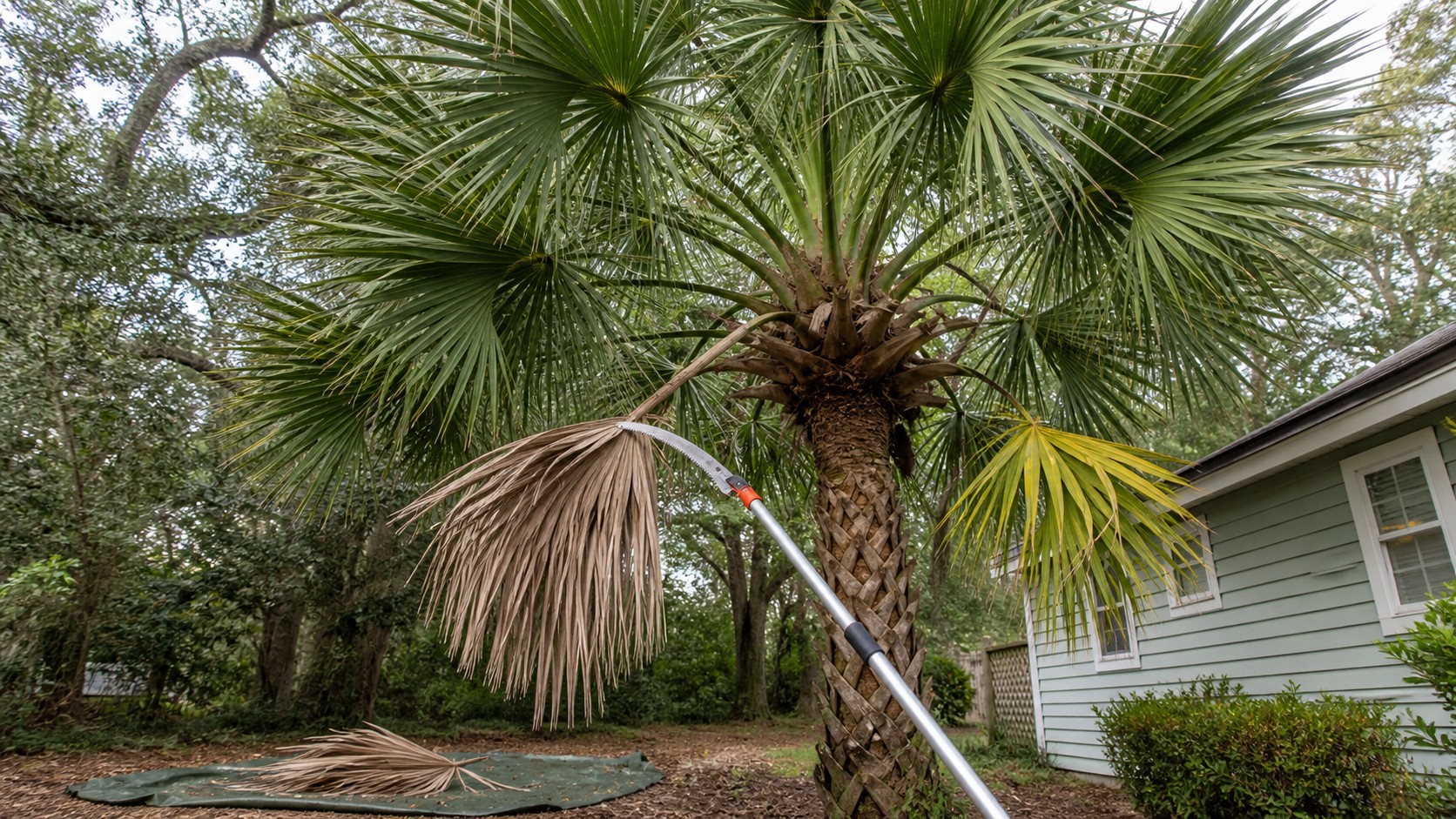
A palm with a tidy feather-duster crown can be a badly pruned palm. In Jacksonville, storm season often triggers requests to strip fronds for “wind resistance,” while yellow lower leaves are cut away to make a nutrient problem disappear from view. Both choices can remove functioning tissue without proving that the palm is safer.
Use three labels before making one cut
Photograph all sides of the palm and assign every questioned item to one of three buckets. “Remove” covers fully brown hanging fronds, broken material threatening a target, and flower or fruit stalks deliberately included in the scope. “Retain” covers healthy green fronds, especially those at or above horizontal. “Diagnose” covers yellow, orange-spotted, frizzled, distorted, or partly necrotic living leaves.
The labels keep appearance from becoming the only acceptance standard. UF/IFAS describes a healthy properly pruned palm as having a round canopy with green leaves down to the bottom, not a narrow tuft. Some crownshaft palms shed old leaves naturally and may need little or no routine pruning when properly nourished.
| What you see | Initial decision | Evidence to collect | Common bad shortcut |
|---|---|---|---|
| Fully brown frond hanging below the crown | Remove if access and drop zone are controlled | Attachment, targets below, cut location, disposal route | Cutting into trunk tissue to make the base look flush |
| Green horizontal or upward frond | Retain | Color, connection, canopy position, conflicts | Removing it for a symmetrical “hurricane cut” |
| Oldest fronds yellow, orange-spotted, or tip-burned | Diagnose | Species, symptom progression, soil and fertilizer history, drainage and irrigation | Cutting symptoms away while deficiency advances upward |
| Frond crosses or smothers the central bud after a storm | Evaluate for careful removal | Bud access, break point, remaining green connection, safe reach | Removing every bent green frond |
| Loose fruit or flower stalk over a walkway | Scope separately | Target use, species, maturity, drop risk, cutting access | Using stalk removal as permission to thin the canopy |
The hurricane cut fails the storm-prep test
A hurricane cut removes most older leaves and leaves only the youngest tuft. UF/IFAS observations after Florida’s 2004 and 2005 hurricane seasons found these overpruned palms more likely to have crowns snapped than nearby fuller-canopied palms. The younger leaves left behind have not hardened like older leaves and lose the support of older leaf bases.
That makes “less leaf area” an incomplete theory of safety. Before storm season, prioritize material that is already dead, detached, broken, or positioned over a consequential target. Preserve healthy canopy structure. Also inspect the ground, trunk, root plate, central spear, and crown attachment; pruning cannot correct movement at the base, trunk decay, a compromised bud, or an unsuitable target relationship.
Do not wait for a named storm to begin high-canopy work. Wind, rain, wet ground, limited access, and rushed debris handling make a poor work environment. A written estimate should define the palm, the exact material, equipment access, drop zone, nearby utilities, property boundary, cleanup, and the condition that will be checked afterward.
Yellow is information, not automatic waste
Palms can move potassium, nitrogen, and magnesium from older leaves to support newer growth. UF/IFAS warns that removing potassium-deficient older fronds can push the palm to draw from the next tier of green leaves and can accelerate decline in severely deficient palms. A yellowing lower frond may therefore be both living tissue and evidence.
Bank close photographs of the oldest, middle, and newest leaves. Record whether symptoms are symmetrical, whether new growth is distorted, and whether the central spear is firm. Identify the palm before choosing a nutrient response. Soil pH, drainage, salinity, limited rooting volume, irrigation water, and fertilizer history can alter what the symptom means.
Do not place fertilizer into a generic pruning ticket. Diagnosis, product analysis, application boundary, timing, and irrigation interaction should be written separately. Jacksonville’s sandy soils can leach nutrients, but that local condition does not prove which element a specific palm lacks. Review the site’s sandy coastal soil guide as context, not as a substitute for diagnosis.
Protect the bud, trunk, and tool path
A palm has one primary growing point near the crown. A cut or puncture that injures that bud can be fatal. Cuts should avoid living trunk tissue, and climbing methods should not place spikes into a palm that is intended to remain. The drop path must keep heavy fronds away from people, glass, roofs, vehicles, power lines, and the remaining crown.
Tool hygiene matters because pruning can move disease material. UF/IFAS specifically documents Fusarium wilt transfer on contaminated tools used on Canary Island date palms and recommends disinfecting tools between palms when that disease is involved. A diagnostic scope should flag unusual one-sided decline or rapid canopy symptoms before crews make repeated living cuts across several palms.
Ask how the cut will be reached and controlled, not just how high the palm is. If work approaches conductors or cannot be completed from a stable setup outside the drop zone, stop and use the appropriate qualified tree-work provider. Do not improvise a pole-saw operation from a roof, extension ladder, or wet surface.
Confirm whether the palm is actually on private property
In consolidated Jacksonville and Duval County, the visible yard edge does not always establish ownership. City Urban Forestry says rights-of-way can include the strip near a street and areas beside city-maintained ditches. The City inspects requests and determines whether a tree is within public property.
If the palm stands near a sidewalk, utility pole, street, ditch bank, or other ambiguous edge, confirm the parcel and right-of-way before authorizing work. The City’s process for public-tree work is separate from a private landscape quote. Jacksonville also notes that ditch-bank trees can provide erosion control, so a contractor should not infer permission from access alone.
Pruning is not removal. If the proposed work could kill the palm, remove it, grind structural roots, or change an approved commercial landscape plan, stop and verify the applicable City review rather than relying on a routine-maintenance assumption. The site’s Jacksonville permit guide provides a starting checklist, but the parcel and proposed scope control the answer.
Debris ownership changes when a company makes the cut
Jacksonville’s residential yard-waste page accepts palm fronds generated by the resident when they meet the City’s collection rules. The current standards cap setout at five cubic yards, limit any single container or item to 40 pounds, and direct residents not to use automated service carts for yard waste.
The commercial boundary is different: the City states that tree waste produced by a tree surgeon or similar commercial entity must be removed and properly disposed of by that company. Do not let a bid quietly transfer commercial pruning debris to the resident’s curb. The proposal should name loading, hauling, disposal, cleanup, and responsibility for material left after the work.
Palm fronds can be bulky, armed, and difficult to compact. Stage them without blocking a sidewalk, drain, ditch, driveway sight line, or emergency access. Separate stump or trunk work from frond cleanup because weight, dimensions, equipment, and disposal requirements change.
Write acceptance around the remaining palm
After pruning, compare the result with the pre-work photographs. The canopy should remain round and species-appropriate. The central spear and bud should be untouched. Retained fronds should not show saw damage, trunk tissue should not be gouged, and no loose cut material should remain lodged in the crown.
The closeout record should list what was removed, what was deliberately retained, what symptom was referred for diagnosis, how tools were managed, where debris went, and any new defect observed at access height. If a palm needs continuing care, connect the scope to the local landscape calendar rather than scheduling repeated cosmetic stripping.
For a property-specific scope, use the written quote request and identify each palm, ownership boundary, target below, remove/retain/diagnose labels, access method, and debris responsibility.